Enneagram 6 and 7 Compatibility: Love & Work
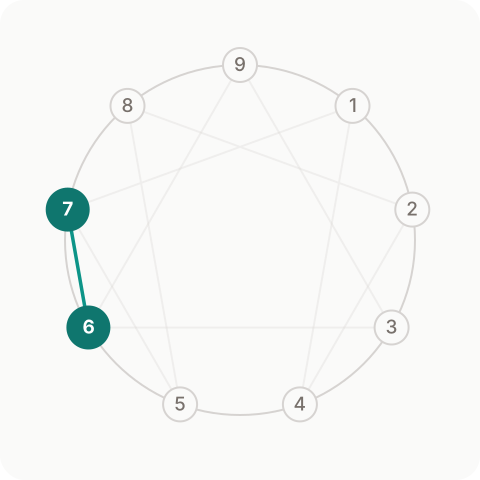
In love
The brake and the accelerator. The Seven pulls the Six toward possibility; the Six pulls the Seven toward consequence. Together: motion with seatbelts.
At work
Plans get both wings and landing gear. Argue scenarios, not character.
The recurring fight
The signature collision: the Loyalist argues from the threat, worst cases deployed as evidence, while the Enthusiast reframes mid-fight — it’s not that bad, look at it this way. What de-escalates this specific pairing: the Type-6 partner gets steadiness — the reassurance said before it’s extracted; the Type-7 partner gets one full acknowledgment of the problem before any silver lining. Order matters less than both arriving in the same conversation.
What each needs from the other
The Loyalist 6
From a Seven, the Six needs commitments kept boringly — the plan executed as spoken, changes negotiated before rather than after — because every cheerful revision teaches the Six to plan alone.
The Enthusiast 7
From a Six, the Seven needs worries batched, not streamed — the concerns gathered into one conversation instead of seasoning every plan — and its optimism enjoyed at least as often as it’s audited.
Daily life together
Her contingencies, his possibilities — the packed emergency kit in the trunk of the road-trip car. He pulls her toward the horizon; she checks the weather on it. When balanced, it’s motion with seatbelts: adventures that actually happen because someone booked refundable. The seesaw tips when his reframes dismiss her radar, or her radar grounds his flights.
When it thrives
Thriving looks like motion with seatbelts fastened by choice: his horizons checked but chased, her radar honored but scheduled. In the healthy version the seesaw becomes a launch mechanism — her ground gives his flights a runway, his lift gives her vigilance somewhere worth guarding.
How the attraction works
The tradition frames this pairing as two projectors aimed at opposite futures: the Seven’s positive visioning and the Six’s worst-case envisioning are both projections, and each partner mistakes its own for realism. The attraction is the completion each offers: the Seven pulls the Six toward possibilities its scanner would never authorize alone, and the Six gives the Seven’s flights a ground crew — someone who actually reads the contracts. Their opposite assumptions run deep: the Seven sees relationship as unlimited possibility; the Six feels bound by duty and hard work — and each is genuinely enriched by the half it lacks.
Reality testing as a couple’s practice
The casework names the pairing’s central discipline: reality testing — because when one partner sees the worst and the other the best, the truth needs a procedure. The critical warning is one-sided: when Troopers are told to lighten up, they become more deeply afraid — the Seven’s reflexive reframe, meant as a gift, lands as dismissal and confirms the Six’s fear that nobody’s watching the road. The protocol that works: the Six’s concern heard completely before any brighter read is offered, then both projections tested against evidence — a couple’s habit of asking ‘what do we actually know?’ that converts the polarity from argument into method. Run well, it’s motion with seatbelts: adventures that happen because someone checked the weather and booked refundable.
At work: wings and landing gear
Professionally the pair gives every plan both wings and landing gear — the Seven’s options and the Six’s contingencies. The documented rule: argue scenarios, not character. The failure mode is mutual diagnosis (the Seven calling the Six’s caution a character flaw, the Six calling the Seven’s optimism recklessness); the working mode keeps both projections on the table as data. What helps structurally: the Six’s concerns batched into scheduled reviews rather than seasoning every conversation, the Seven’s pivots negotiated before rather than after (each cheerful revision teaches the Six to plan alone), and roles honored as functions — the Seven owns upside scenarios, the Six owns downside ones, and decisions require one of each.
Go deeper
This page sketches the average band; your actual pairing shifts with each partner’s wing, instinct stack and current level. For this pairing specifically, Type 6 vs Type 7 sharpens the individual contrast. For the complete interactive analysis, see the Pro report.
Frequently asked questions
Do Type 6 and Type 7 work as a couple?
Her contingencies, his possibilities — the packed emergency kit in the trunk of the road-trip car. Whether it thrives depends more on both partners' health levels than on the combination — this page maps where this specific pairing's friction and strength live.
Where does a 6-7 couple clash most?
What de-escalates this specific pairing: the Type-6 partner gets steadiness — the reassurance said before it's extracted; the Type-7 partner gets one full acknowledgment of the problem before any silver lining. Order matters less than both arriving in the same conversation.
How do Type 6 and Type 7 handle stress differently?
Their stress signatures differ, and knowing both helps: under stress, Sixes perform like an unhealthy Three: workaholic proving, image management, competing for security. Meanwhile, under stress, Sevens turn harsh like an unhealthy One: critical, impatient, perfectionistic about their escapes. Reading a partner's bad season through their stress arrow — instead of taking it personally — is this pairing's cheapest repair.
What growth directions help a 6-7 couple?
Each partner's growth line points the way: moving toward health, Sixes gain Nine's calm: trusting themselves and life enough to rest inside it. And for the other: moving toward health, Sevens gain Five's depth: fewer things, fully tasted; satisfaction replaces anticipation. A couple that names these two directions out loud can back each other's practice instead of accidentally blocking it.
What does the Type 6 partner need in this relationship?
In love, Sixes offer loyalty that outlasts moods. They need consistency — surprises and mixed signals wake the inner alarm. In this pairing specifically, that need meets the The Enthusiast's pattern — naming it early keeps it a request instead of a resentment.
Know your enneagram type. Understand yourself.
Start 7-day free trial