Enneagram 5 and 8 Compatibility: Love & Work
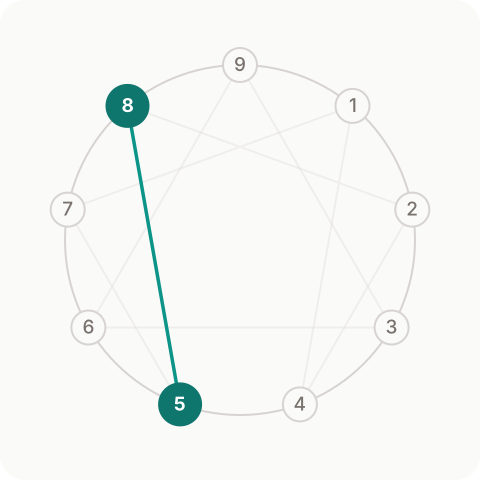
In love
Quiet power and loud power. The Eight respects the Five’s unshakable mind; the Five trusts the Eight’s unshakable presence. Neither does small talk — they do loyalty.
At work
Strategy and force. The Five aims, the Eight fires. Agree on who can veto — and accept the veto.
The recurring fight
The signature collision: the Investigator withdraws and sends the memo, while the Challenger arrives at full volume immediately and respects pushback. What de-escalates this specific pairing: the Type-5 partner gets time to process before the resolution round; the Type-8 partner gets ground stood without contempt. Order matters less than both arriving in the same conversation.
What each needs from the other
The Investigator 5
From an Eight, the Five needs thinking time granted without suspicion — the pause before answering isn’t evasion — and intensity offered as invitation, never as siege.
The Challenger 8
From a Five, the Eight needs presence at the table during conflict — the memo doesn’t count — because withdrawal mid-fight reads to an Eight as contempt, and contempt is the one unforgivable.
Daily life together
The strategist and the force, allied: his analysis aims her power, her decisiveness executes his conclusions. Deep mutual respect, low mutual noise. The collision is rhythm: she moves at insult-speed, he at understanding-speed, and in conflict her siege meets his drawbridge — which reads to her as contempt, the one thing she can’t negotiate with.
When it thrives
Thriving looks like the war room at peace: his analysis aiming her force, her decisiveness honoring his need to understand first. In the healthy version the conflict protocol holds — she brings the siege down to a knock, he stays at the table past his budget — and together they’re the couple nobody outmaneuvers.
How the attraction works
The tradition’s report from inside this pairing overturns its public image: at home, the aggressive Boss looks remarkably tame and the Observer seems to have taken assertiveness training. Fives are far more outspoken in the security of their own home — an attitude that dovetails exactly with the Eight’s demand for truth. The documented effect is enlivening: the Eight’s anger pushes the Five to have its feelings in the moment rather than filing them for later processing, and though Fives detest every battle, they usually concur that the Boss lessons produce results. Quiet power and loud power turn out to be the same respect for reality, differently dressed.
The voltage exchange
What the Eight gives the Five is documented: emotional energy, immediacy, the experience of being met by force without being destroyed by it. What the Five gives the Eight is the mirror gift: a partner whose mind can’t be pushed — analysis that holds its ground without needing volume — and whose containment gives the Eight’s intensity a place to land without escalation. The strain is conflict mechanics: the Eight sieges (present, loud, now) and the Five withdraws (absent, silent, later), and each maneuver amplifies the other. The treaty this material supports: the Eight brings the siege down to a knock (one direct question, then space), and the Five stays at the table past its budget — because the tradition’s finding is precisely that the Five’s in-the-moment engagement, however costly, is what converts these battles into the enlivenment both partners report.
At work: the strategist and the force
Professionally the geometry is clean: the Five aims, the Eight fires — analysis directing power, decisiveness executing insight. Neither wastes the other’s time with performance; both respect competence delivered without decoration. The frictions: tempo (the Eight moves at conviction-speed, the Five at understanding-speed) and credit for invisible work (the Five’s analysis is the campaign’s foundation and never visible in its victory photos). What works: veto rights explicitly granted and honored (the Five can stop a move it hasn’t verified; the Eight can force a decision past the Five’s last 10% of certainty — each yields their weaker domain), presence required at the table during conflict (the Five’s memo doesn’t count; withdrawal mid-fight reads as contempt, the one unforgivable), and the Eight naming the Five’s contribution publicly — territory-marking on the Five’s behalf, which the Five will never do for itself.
Go deeper
Treat the map above as the default physics, not the forecast — self-knowledge rewrites most of it, and levels outweigh combinations. For this pairing specifically, Type 5 vs Type 8 sharpens the individual contrast. The Pro compatibility tool goes further, including observer-mode typing for a partner who won’t take the test.
Frequently asked questions
Is a 5-8 relationship compatible?
The strategist and the force, allied: his analysis aims her power, her decisiveness executes his conclusions. Whether it thrives depends more on both partners' health levels than on the combination — this page maps where this specific pairing's friction and strength live.
What do Type 5 and Type 8 fight about?
What de-escalates this specific pairing: the Type-5 partner gets time to process before the resolution round; the Type-8 partner gets ground stood without contempt. Order matters less than both arriving in the same conversation.
How do Type 5 and Type 8 handle stress differently?
Their stress signatures differ, and knowing both helps: under stress, Fives scatter into Seven's restlessness: jumpy, distracted, escaping into projects and stimulation. Meanwhile, under stress, Eights withdraw like an unhealthy Five: secretive, strategizing alone, trusting no one. Reading a partner's bad season through their stress arrow — instead of taking it personally — is this pairing's cheapest repair.
What growth directions help a 5-8 couple?
Each partner's growth line points the way: moving toward health, Fives gain Eight's embodied confidence: acting on knowledge instead of collecting more. And for the other: moving toward health, Eights gain Two's open heart: strength in service, protection with tenderness. A couple that names these two directions out loud can back each other's practice instead of accidentally blocking it.
What does the Type 5 partner need in this relationship?
In love, Fives give presence in small, real doses and deep loyalty. They need unhurried space — intimacy grows when it doesn't demand. In this pairing specifically, that need meets the The Challenger's pattern — naming it early keeps it a request instead of a resentment.
Know your enneagram type. Understand yourself.
Start 7-day free trial