Two Type 5s Together: Enneagram 5-5 Compatibility
In love
Two fortresses with a private bridge. Silence together is intimacy; the risk is parallel lives that never merge. Name feelings on a schedule if need be.
At work
A think tank of two. Depth unlimited, outreach zero. Force external contact weekly.
The recurring fight
When two Type 5s clash, both run the same play: each withdraws and sends the memo. The collision is symmetric — both run the same play, so neither supplies the counterweight. What breaks the symmetry: one partner deliberately supplies what both are waiting for — for two Type 5s, that means time to process before the resolution round, offered first, without scoreboard.
What each needs from the other
The Investigator 5 + 5
Two Fives need scheduled bridges — the weekly conversation that happens by calendar, not mood — because two contented fortresses can run parallel lives indefinitely without noticing the moat widened.
Daily life together
Two studies, one kitchen, an atmosphere of profound mutual non-intrusion. Their conversations, when they occur, are the best either has all week. The moat grows by default: without one scheduled bridge — the standing dinner, the shared project — two contented solitudes can cohabit into strangerhood, comfortably.
When it thrives
Thriving looks like the think tank with a hearth: two depths compounding, the weekly bridge crossed by ritual, the moat maintained against the world but never between them. In the healthy version the fortress becomes what neither could build alone — a shared interior larger than both.
How the attraction works
The tradition’s field notes include a story that captures this pairing whole: a couple who met without a shared language, courted through gestures and guidebook phrases, and married within two weeks — because, as one partner later explained, the silence freed her to feel: no explanations required, no draining expectations, interaction always a choice. Double Fives often live well together for exactly this reason: total mutual respect of boundaries. From outside it may not look like much is happening — little small talk, little hugging — but the unspoken bond can be palpable. Both partners relax around someone who contains emotion; both know the automatic contraction when others’ expectations invade the silence.
Separate wings, prearranged meetings
The tradition records double-Five households organized with architectural honesty: sometimes literally separate sections of the house, each with its own entrance — floor space divided, together-time prearranged for evenings out or when the children are home. Plenty of family activity is possible so long as there’s recovery time, because Five hell is an uncontrolled environment where anyone can barge in. The design insight for less extreme versions: this couple’s intimacy is the respected boundary, and its risk is the same boundary compounding into strangerhood. The maintenance is the scheduled bridge — one standing, deliberate crossing per week that neither cancels — because two contented solitudes will never generate contact spontaneously, and both partners genuinely want the contact they won’t initiate.
At work: the think tank’s interface problem
Professionally, two Fives compound depth: research, analysis, systems — the quality of thought is never the issue. The documented weaknesses are interface and initiative: nothing gets communicated until it’s complete (and ‘complete’ recedes), meetings are avoided as depletion, and the external world — clients, allies, markets — goes untended by two people who each assumed the other found it as draining. What works: a designated external voice (one partner takes the interface role per project, explicitly, with recovery time budgeted), forced intermediate shipping (the 80%-draft shared on schedule — each Five tolerates exposure better when the rule applies to both), and the weekly synchronization both would skip — fifteen minutes, agenda fixed, because two parallel fortresses can otherwise duplicate work for months without noticing.
Go deeper
Treat the map above as the default physics, not the forecast — self-knowledge rewrites most of it, and levels outweigh combinations. For a household of two Type 5s, each partner’s wing page is where the differences hide. The Pro compatibility tool goes further, including observer-mode typing for a partner who won’t take the test.
Frequently asked questions
Is a 5-5 relationship compatible?
Two studies, one kitchen, an atmosphere of profound mutual non-intrusion. Whether it thrives depends more on both partners' health levels than on the combination — this page maps where this specific pairing's friction and strength live.
What do Type 5 and Type 5 fight about?
What breaks the symmetry: one partner deliberately supplies what both are waiting for — for two Type 5s, that means time to process before the resolution round, offered first, without scoreboard.
How does a double Type 5 couple handle stress?
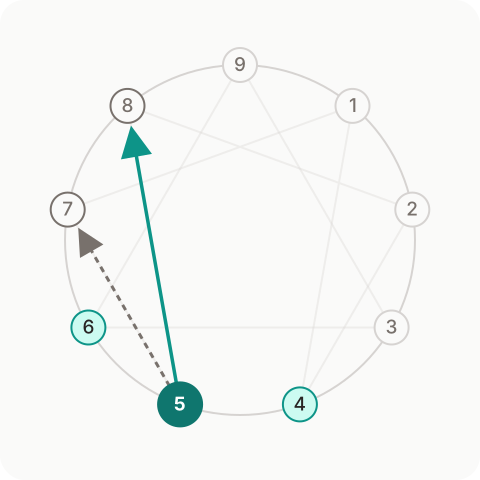
Doubly, in the same direction: under stress, Fives scatter into Seven's restlessness: jumpy, distracted, escaping into projects and stimulation. When both partners travel that arrow at once, nobody holds the baseline — which is why same-type couples benefit from an outside stabilizer and an agreed signal for hard weeks.
What growth work helps two Type 5s most?
The shared growth line is an advantage: moving toward health, Fives gain Eight's embodied confidence: acting on knowledge instead of collecting more. Two people working the same direction can genuinely accelerate each other — provided they don't also share the same excuse on the same day.
What does each partner in a 5-5 couple need to hear?
In love, Fives give presence in small, real doses and deep loyalty. They need unhurried space — intimacy grows when it doesn't demand. In this pairing specifically, that need meets the The Investigator's pattern — naming it early keeps it a request instead of a resentment.
Know your enneagram type. Understand yourself.
Start 7-day free trial