Enneagram 4 and 9 Compatibility: Love & Work
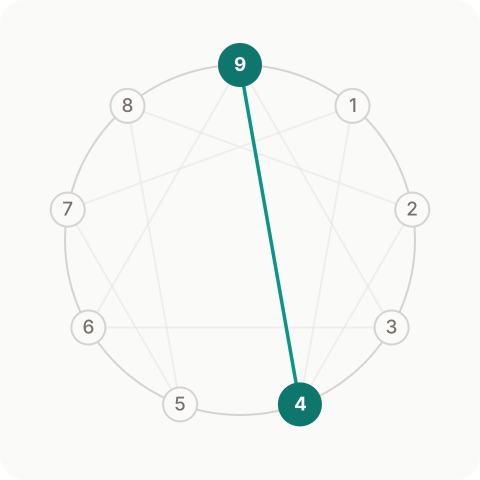
In love
The wave and the shore. The Nine’s calm holds the Four’s surges without judging them. Risk: the Four mistakes peace for indifference; the Nine mistakes depth for danger.
At work
Aesthetics and acceptance. Gentle, unhurried, humane — bring your own urgency.
The recurring fight
The signature collision: the Individualist argues from the wound, where this fight is also every previous one, while the Peacemaker agrees in the room and resists after it. What de-escalates this specific pairing: the Type-4 partner gets the feeling validated before any interpretation is contested; the Type-9 partner gets disagreement made explicitly safe, with time for the real answer. Order matters less than both arriving in the same conversation.
What each needs from the other
The Individualist 4
From a Nine, the Four needs engagement with its depths — real answers to real questions, not mirroring — because the Nine’s peace can feel like absence to someone hungry to be met.
The Peacemaker 9
From a Four, the Nine needs storms labeled as passing — and appreciation for its steadiness spoken, because being the shore is work even when it looks like standing still.
Daily life together
The wave and the shore, domesticated: her surges land on his acceptance and lose their danger. Nobody has ever made her feel less judged; nobody has ever taken his stillness less personally. The erosion risk: her need to be met with equal fire finds sand instead, while her weather slowly wears his peace — both settling for a calm neither chose.
When it thrives
Thriving looks like the wave and shore in conversation: her surges met with real answers, his peace defended by her fire when the world pushes. In the healthy version she stops mistaking calm for absence, he stops mistaking depth for danger — and the home becomes both harbor and sea.
How the attraction works
The tradition states each partner’s deepest wish in one sentence: Fours describe a lifelong yearning to be awakened through love, while Nines seek vitality and an agenda from a mate. At their best, each can love the other dispassionately, without expectation or blame — the Nine’s spacious acceptance holding the Four’s surges without judgment, the Four’s fire warming the Nine’s fog. The casework’s warning names the low point with equal precision: each expects the other to deliver the impossible — the Romantic craves permanent emotional satisfaction, and the Mediator wants to be handed a life.
The impossible assignments
The pairing’s failure mode is two undeliverable job descriptions quietly exchanged: the Four hires the Nine as the love that will finally complete it, and the Nine hires the Four as the vitality that will finally animate it. Both employees inevitably underperform, and each partner reads the shortfall as the other’s withholding rather than the assignment’s impossibility. The repair is resigning the impossible jobs explicitly: the Four’s completeness is its own work (the missing thing was never the partner’s to supply), and the Nine’s agenda must be its own discovery (borrowed vitality evaporates by design). What remains when the impossible jobs are resigned is the pairing’s real treasure — the wave and the shore, each doing what it actually can: acceptance that doesn’t judge, fire that doesn’t demand.
At work: aesthetics and acceptance
Professionally this is the gentlest deep pairing: the Four’s taste and meaning-making inside the Nine’s steady, inclusive calm. Clients and colleagues experience the combination as humane and unhurried — nothing is churned, nobody is steamrolled. The structural gap is urgency: the Four moves on inspiration, the Nine on routine, and neither generates deadlines natively; the documented compound risk is a beautiful practice with a backlog. What works: imported urgency (external deadlines, a shared operations tool neither can quietly ignore), the division of veto — the Four owns quality-of-feeling, the Nine owns everyone-on-board — and mutual translation duty: the Four surfaces the Nine’s buried opinions (‘you went quiet — what did you actually think?’), the Nine grounds the Four’s spirals (’the work is good; the mood will pass; ship it’).
Go deeper
Wings, instincts and health levels all modulate the 4-9 dynamic — health trumps type-matching everywhere. For this pairing specifically, Type 4 vs Type 9 sharpens the individual contrast. The Pro report assembles the full picture for your specific pairing.
Frequently asked questions
Are Type 4 and Type 9 a good match?
The wave and the shore, domesticated: her surges land on his acceptance and lose their danger. Whether it thrives depends more on both partners' health levels than on the combination — this page maps where this specific pairing's friction and strength live.
What is the recurring conflict in a 4-9 pair?
What de-escalates this specific pairing: the Type-4 partner gets the feeling validated before any interpretation is contested; the Type-9 partner gets disagreement made explicitly safe, with time for the real answer. Order matters less than both arriving in the same conversation.
How do Type 4 and Type 9 handle stress differently?
Their stress signatures differ, and knowing both helps: under stress, Fours grasp like an unhealthy Two: clinging, needing to be needed, testing people's love. Meanwhile, under stress, Nines fret like an unhealthy Six: anxious, reactive, scanning for what could break the peace. Reading a partner's bad season through their stress arrow — instead of taking it personally — is this pairing's cheapest repair.
What growth directions help a 4-9 couple?
Each partner's growth line points the way: moving toward health, Fours gain One's discipline: feelings become material for work instead of weather that cancels it. And for the other: moving toward health, Nines gain Three's self-investment: their own goals get calendar time and follow-through. A couple that names these two directions out loud can back each other's practice instead of accidentally blocking it.
How do Type 4 and Type 9 collaborate at work?
At work, Fours bring taste, meaning and originality. Friction: routine drains them, and comparison stings. And the other side: at work, Nines mediate, steady the room, and see all sides. Friction: priorities blur, and 'no' arrives late or never. The collaboration works when each covers the other's friction point on purpose.
Know your enneagram type. Understand yourself.
Start 7-day free trial