Enneagram 4 and 6 Compatibility: Love & Work
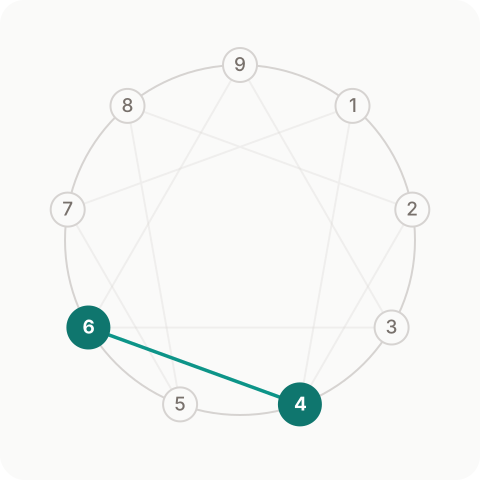
In love
Intensity meets loyalty. The Six stays through the Four’s storms — and needs to hear that it matters. Reassurance is this pair’s love language.
At work
Depth plus diligence. The Four resists the process; the Six protects it. Trade: soul in the output, structure in the path.
The recurring fight
The signature collision: the Individualist argues from the wound, where this fight is also every previous one, while the Loyalist argues from the threat, worst cases deployed as evidence. What de-escalates this specific pairing: the Type-4 partner gets the feeling validated before any interpretation is contested; the Type-6 partner gets steadiness — the reassurance said before it’s extracted. Order matters less than both arriving in the same conversation.
What each needs from the other
The Individualist 4
From a Six, the Four needs its uniqueness enjoyed rather than risk-assessed — and steadiness offered without the Four having to earn it by being less.
The Loyalist 6
From a Four, the Six needs drama distinguished from danger out loud — ’this is a storm, not a shipwreck’ — because the Six’s alarm can’t tell them apart from inside.
Daily life together
Her depth gives his loyalty something worth guarding; his steadiness gives her storms a harbor. She teaches him that feelings aren’t threats; he teaches her that support can be boring and still be love. The trap: her intensity triggers his alarm, his alarm reads as abandonment, and both catastrophize in different dialects.
When it thrives
Thriving looks like the harbor with heat: her storms received as weather rather than threat, his loyalty received as devotion rather than dullness. In the healthy version the reassurance flows both ways on schedule — and the pairing becomes what both feared didn’t exist: intensity that stays.
How the attraction works
The tradition’s observation is that the shared perceptions strengthen rather than divide this couple: Romantics can be as fearful as any Six, and Troopers can feel plugged into the same sense of universal suffering that characterizes Fours. They stand together in sorrow — and therefore share equally compelling emotional victories; both are privy to the depth of purpose and meaning that voluntary suffering produces. Two different engines produce the same weathered wisdom: the Four’s alienation and the Six’s vigilance both know the world isn’t simple, and each finds in the other a witness who doesn’t need convincing.
Storm and alarm, distinguished
The couple’s tangle is that each partner’s turbulence triggers the other’s: the Four’s emotional storms read as danger on the Six’s threat-scanner, and the Six’s anxious spirals read as abandonment on the Four’s attachment radar. Both escalate defensively and the household loses its floor. The distinguishing practice, documented earlier on this site and grounded in both types’ casework: naming out loud which weather is present — ’this is a storm, not a shipwreck’ (the Four labeling drama as non-danger) and ’this is my scanner, not about us’ (the Six labeling anxiety as non-verdict). The reward for the calibration is the pairing’s specific gift: intensity that stays — the Six’s loyalty giving the Four’s depth the permanence it never believed in, the Four’s fire giving the Six’s devotion something worth guarding.
At work: depth plus diligence
Professionally the Four brings the meaning and the Six protects the process — soul in the output, structure in the path, when the exchange is honored. The Four resists procedure as deadening; the Six defends it as the thing that keeps everyone safe; both are describing real functions. The frictions from the casework patterns: the Four’s mood-driven pacing sets off the Six’s reliability alarms, and the Six’s contingency questions land on the Four as doubts about its vision. What works: the Four commits to a small number of hard commitments (fewer, honored absolutely — which the Six can bank), the Six routes its risk-questions to scheduled reviews rather than inspiration’s doorstep, and both use their shared underdog instinct outward — this pair defends colleagues and causes with rare combined force.
Go deeper
Wings, instincts and health levels all modulate the 4-6 dynamic — health trumps type-matching everywhere. For this pairing specifically, Type 4 vs Type 6 sharpens the individual contrast. The Pro report assembles the full picture for your specific pairing.
Frequently asked questions
Are Type 4 and Type 6 a good match?
Her depth gives his loyalty something worth guarding; his steadiness gives her storms a harbor. Whether it thrives depends more on both partners' health levels than on the combination — this page maps where this specific pairing's friction and strength live.
What is the recurring conflict in a 4-6 pair?
What de-escalates this specific pairing: the Type-4 partner gets the feeling validated before any interpretation is contested; the Type-6 partner gets steadiness — the reassurance said before it's extracted. Order matters less than both arriving in the same conversation.
How do Type 4 and Type 6 handle stress differently?
Their stress signatures differ, and knowing both helps: under stress, Fours grasp like an unhealthy Two: clinging, needing to be needed, testing people's love. Meanwhile, under stress, Sixes perform like an unhealthy Three: workaholic proving, image management, competing for security. Reading a partner's bad season through their stress arrow — instead of taking it personally — is this pairing's cheapest repair.
What growth directions help a 4-6 couple?
Each partner's growth line points the way: moving toward health, Fours gain One's discipline: feelings become material for work instead of weather that cancels it. And for the other: moving toward health, Sixes gain Nine's calm: trusting themselves and life enough to rest inside it. A couple that names these two directions out loud can back each other's practice instead of accidentally blocking it.
How do Type 4 and Type 6 collaborate at work?
At work, Fours bring taste, meaning and originality. Friction: routine drains them, and comparison stings. And the other side: at work, Sixes are the early-warning system and the faithful executor. Friction: ambiguity from leadership reads as danger. The collaboration works when each covers the other's friction point on purpose.
Know your enneagram type. Understand yourself.
Start 7-day free trial