Enneagram 4 and 5 Compatibility: Love & Work
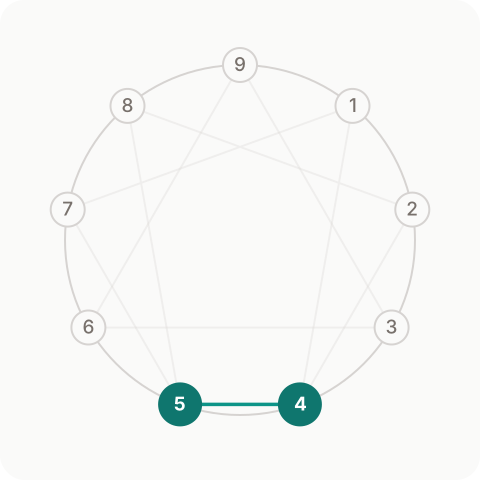
In love
The romantic and the hermit — rich inner worlds that meet in ideas and art. The Four wants emotional contact the Five gives in concentrate. Dose, don’t demand.
At work
Original thinking squared. The Four needs the work to feel; the Five needs it to hold. Both are right.
The recurring fight
The signature collision: the Individualist argues from the wound, where this fight is also every previous one, while the Investigator withdraws and sends the memo. What de-escalates this specific pairing: the Type-4 partner gets the feeling validated before any interpretation is contested; the Type-5 partner gets time to process before the resolution round. Order matters less than both arriving in the same conversation.
What each needs from the other
The Individualist 4
From a Five, the Four needs feelings engaged, not analyzed — ’tell me more’ beats a taxonomy — and the Five’s inner world shared as the intimacy it withholds from everyone else.
The Investigator 5
From a Four, the Five needs emotional weather forecast, not ambush — intensity announced and dosed — and its analysis of feelings received as its way of caring about them.
Daily life together
A household of two interiors: her feelings composed like music, his thoughts built like architecture. They can share silence for hours and call it a good evening — both mean it. The gap: when she finally surfaces needing contact, he may be three floors down in a problem, and neither has a native protocol for knocking.
When it thrives
Thriving looks like the two interiors with a connecting door: her feelings welcomed into his architecture, his thoughts warmed in her weather. The healthy version installs the knock protocol both lacked — and the silence they share becomes the loudest intimacy either has known.
How the attraction works
The tradition names the deep structure: both types enclose themselves in an interior world, but the interiority has vastly different focus. The Five lives in intellectual abstraction and mental imagery curiously devoid of emotional content; the Four is exquisitely attentive to every fluctuation of mood. Heart and mind are such different organs of perception that each can feel misrepresented when expressing itself to the other — and yet each recognizes in the other a fellow inhabitant of depth, someone who also finds the surface world thin. The 4w5/5w4 wing zone makes this the enneagram’s most liminal pairing: two adjacent interiors with a connecting wall.
Heart translated to mind, mind to heart
The couple’s recurring mistranslation is organ-level: the Four expresses a feeling and receives an analysis (which lands as dissection); the Five offers an insight and receives an emotional response (which lands as noise). Each concludes the other missed the point, when each answered in its native perception. The repair is learning the other’s grammar in small doses: the Five prefacing analysis with one sentence of acknowledgment (the feeling registered before it’s examined), the Four packaging one feeling per day as information the Five can process (named, sized, no action required). The documented reward is large: when the translation holds, the Four gets its depths understood — not just witnessed — and the Five gets its understanding felt, the exact completion each interior lacked.
At work: the depth division
Professionally the pair concentrates more interiority than any other combination: original vision from the Four, original analysis from the Five, both allergic to meetings, both at their best in long uninterrupted arcs. Their outputs complete each other — the Four needs the work to feel, the Five needs it to hold — and both are right; the strongest jointly-made things pass both tests. The frictions: tempo (the Four’s inspiration-driven bursts against the Five’s methodical accumulation) and expression (the Four thinking out loud, the Five thinking in silence and resenting the narration). What works: separated workspaces with a scheduled convergence point, roles split by test — feeling-truth is the Four’s veto, structural-truth the Five’s — and external representation assigned deliberately, since neither will volunteer for the room.
Go deeper
Treat the map above as the default physics, not the forecast — self-knowledge rewrites most of it, and levels outweigh combinations. For this pairing specifically, Type 4 vs Type 5 sharpens the individual contrast. The Pro compatibility tool goes further, including observer-mode typing for a partner who won’t take the test.
Frequently asked questions
Is a 4-5 relationship compatible?
A household of two interiors: her feelings composed like music, his thoughts built like architecture. Whether it thrives depends more on both partners' health levels than on the combination — this page maps where this specific pairing's friction and strength live.
What do Type 4 and Type 5 fight about?
What de-escalates this specific pairing: the Type-4 partner gets the feeling validated before any interpretation is contested; the Type-5 partner gets time to process before the resolution round. Order matters less than both arriving in the same conversation.
How do Type 4 and Type 5 handle stress differently?
Their stress signatures differ, and knowing both helps: under stress, Fours grasp like an unhealthy Two: clinging, needing to be needed, testing people's love. Meanwhile, under stress, Fives scatter into Seven's restlessness: jumpy, distracted, escaping into projects and stimulation. Reading a partner's bad season through their stress arrow — instead of taking it personally — is this pairing's cheapest repair.
What growth directions help a 4-5 couple?
Each partner's growth line points the way: moving toward health, Fours gain One's discipline: feelings become material for work instead of weather that cancels it. And for the other: moving toward health, Fives gain Eight's embodied confidence: acting on knowledge instead of collecting more. A couple that names these two directions out loud can back each other's practice instead of accidentally blocking it.
What does the Type 5 partner need in this relationship?
In love, Fives give presence in small, real doses and deep loyalty. They need unhurried space — intimacy grows when it doesn't demand. Beside a The Individualist, that need is the one most worth saying out loud rather than hoping into existence.
Know your enneagram type. Understand yourself.
Start 7-day free trial