Enneagram 3 and 6 Compatibility: Love & Work
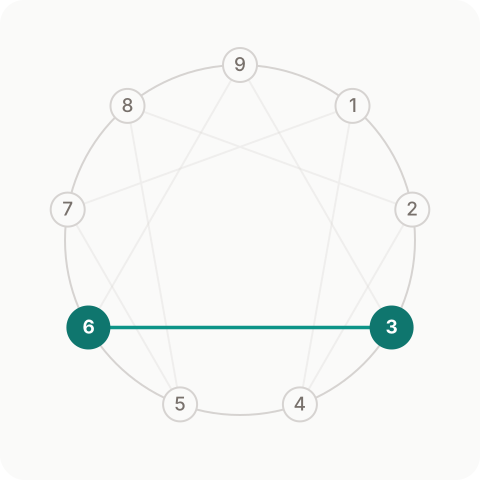
In love
Confidence and caution. The Six doubts the Three’s shine; the Three hates being doubted. Trust builds slowly, through kept promises, not presentations.
At work
Ambition with a risk officer. The Six’s questions are quality control, not sabotage — say so out loud.
The recurring fight
The signature collision: the Achiever argues to win efficiently and move on, while the Loyalist argues from the threat, worst cases deployed as evidence. What de-escalates this specific pairing: the Type-3 partner gets the problem separated from its worth; the Type-6 partner gets steadiness — the reassurance said before it’s extracted. Order matters less than both arriving in the same conversation.
What each needs from the other
The Achiever 3
From a Six, the Three needs doubts delivered as questions, not audits — ‘walk me through it’ instead of ’that won’t work’ — and its optimism trusted once verified.
The Loyalist 6
From a Three, the Six needs promises sized to reality — the under-promise kept beats the impressive one revised — and bad news delivered early, not managed.
Daily life together
Her momentum, his brakes — infuriating and mutually life-saving. He stress-tests her ventures before the market can; she drags his caution toward opportunities it would have scanned forever. The marriage’s treaty must be explicit: doubts get a scheduled hearing, wins get an unqualified toast.
When it thrives
Thriving looks like ambition with a licensed auditor: her ventures stress-tested with love, his caution rewarded with wins it can believe in. In the healthy version doubt and drive stop competing — the questions get their hearing, the toast gets its unqualified glass.
How the attraction works
The tradition frames this pairing’s whole arc as the tension between performance and performance anxiety. The Three is a go-getter whose key relationship concept is stop — having to stop and talk about the relationship activates its deepest worth-anxiety, so it speeds up exactly when the more internalized Six wants to slow down and discuss doubts. Underneath the collision is real complementarity: the Six’s questions are the quality control the Three’s optimism lacks, and the Three’s confidence is the forward gear the Six’s deliberation lacks. Each carries precisely the function the other’s pattern deleted.
Timing the hard conversations
The casework’s tactical advice for this couple is unusually specific: a wise Six times emotional discussions to coincide with shared activity. A Three relates through the filter of doing, and needs to be shown that feelings do not mean a dead halt to the pleasures and rewards of work — the conversation that happens on the hike lands where the sit-down summit fails. The reciprocal move: the Three learns to treat the Six’s doubts as data rather than disloyalty, answering the actual question instead of re-selling the vision — because doubt that gets a straight answer settles, while doubt that gets a pitch escalates. Trust between these two is built in kept promises, sized honestly: the under-promise delivered beats the impressive one revised.
At work: ambition with a risk officer
Professionally the pair maps to the classic founder-and-risk-officer geometry: the Three drives toward the goal, the Six stress-tests the route. Run well, the Six’s scenario-scanning saves the Three from the exact failures its reframing habit hides, and the Three’s momentum saves the Six from analysis without end. The frictions are documented on both sides: the Three experiences the Six’s questions as brakes applied at speed; the Six experiences the Three’s spin as evidence that nothing said can be trusted. What works: doubts delivered as specific questions with a decision deadline attached, wins celebrated without a hedge attached, and bad news traveling instantly — the Three’s instinct to manage information is, to a Six, the single most trust-corrosive behavior available.
Go deeper
Wings, instincts and health levels all modulate the 3-6 dynamic — health trumps type-matching everywhere. For this pairing specifically, Type 3 vs Type 6 sharpens the individual contrast. The Pro report assembles the full picture for your specific pairing.
Frequently asked questions
Are Type 3 and Type 6 a good match?
Her momentum, his brakes — infuriating and mutually life-saving. Whether it thrives depends more on both partners' health levels than on the combination — this page maps where this specific pairing's friction and strength live.
What is the recurring conflict in a 3-6 pair?
What de-escalates this specific pairing: the Type-3 partner gets the problem separated from its worth; the Type-6 partner gets steadiness — the reassurance said before it's extracted. Order matters less than both arriving in the same conversation.
How do Type 3 and Type 6 handle stress differently?
Their stress signatures differ, and knowing both helps: under stress, Threes shut down into Nine's fog: burned out, going through motions, numb behind the smile. Meanwhile, under stress, Sixes perform like an unhealthy Three: workaholic proving, image management, competing for security. Reading a partner's bad season through their stress arrow — instead of taking it personally — is this pairing's cheapest repair.
What growth directions help a 3-6 couple?
Each partner's growth line points the way: moving toward health, Threes gain Six's loyalty: committed to people and causes beyond their own image. And for the other: moving toward health, Sixes gain Nine's calm: trusting themselves and life enough to rest inside it. A couple that names these two directions out loud can back each other's practice instead of accidentally blocking it.
How do Type 3 and Type 6 collaborate at work?
At work, Threes deliver: goals, momentum, adaptability. Friction: image management can outrun candor, and rest feels like falling behind. And the other side: at work, Sixes are the early-warning system and the faithful executor. Friction: ambiguity from leadership reads as danger. The collaboration works when each covers the other's friction point on purpose.
Know your enneagram type. Understand yourself.
Start 7-day free trial