Enneagram 3 and 5 Compatibility: Love & Work
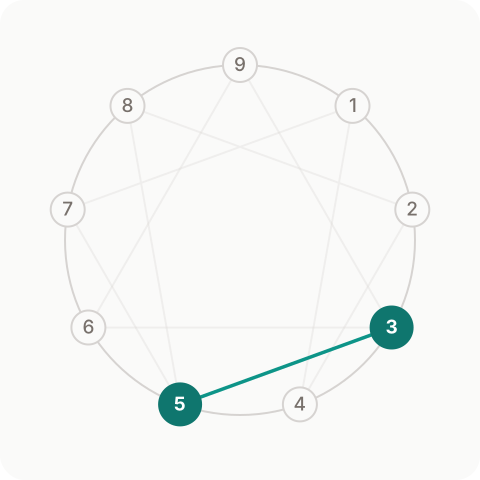
In love
The mover and the observer. The Five needs less of everything the Three does more of. It works when the Three slows to the Five’s depth and the Five voices admiration.
At work
Strategy’s dream: the Five thinks it, the Three sells it. Decide who owns the room and who owns the whiteboard.
The recurring fight
The signature collision: the Achiever argues to win efficiently and move on, while the Investigator withdraws and sends the memo. What de-escalates this specific pairing: the Type-3 partner gets the problem separated from its worth; the Type-5 partner gets time to process before the resolution round. Order matters less than both arriving in the same conversation.
What each needs from the other
The Achiever 3
From a Five, the Three needs its pace forgiven and its wins acknowledged in the Five’s own words — one precise sentence of respect from a Five outweighs a stadium.
The Investigator 5
From a Three, the Five needs meetings that end on time and enthusiasm that doesn’t require co-performance — invited, not conscripted, into the visibility.
Daily life together
The public engine and the private one: she performs the company, he architects it — at home, she narrates the day while he distills it into three sentences that reorganize her week. Trouble arrives as tempo: she processes by presenting, he by retreating, and each mistakes the other’s method for absence.
When it thrives
Thriving looks like strategy fully staffed: his analysis choosing her battles, her execution honoring his depth. The healthy version respects the tempos — she gets her decisions same-day, he gets his nights unscheduled — and the combined range covers everything.
How the attraction works
The tradition reports this as one of the most common Three pairings — in love and in business — and names the stated reason: a balance of opposites. The vast majority of Fives fit the classic introversion profile, and that privacy poses a productive challenge to a Performer whose self-image rests on recognition. The documented early pattern: an almost unopposed movement toward the emotionally distant Five, with the Three commandeering the mechanics of the relationship. When a trip is planned, the Three sends for brochures, builds the itinerary, books the reservations — all the Five has to do is pack and go. Each gets something precise: the Three, a partner who neither competes for the spotlight nor performs; the Five, a life whose logistics arrive pre-solved.
The energy treaty
The pairing’s strain is metabolic before it’s emotional: the Three’s ideal week would hospitalize the Five. Left unmanaged, the Three books the couple into its own tempo, the Five silently pays the energy overdraft, and the eventual withdrawal looks to the Three like rejection when it’s arithmetic. The treaty that works, consistent with both types’ casework: the Three’s plans run on a quota the Five agreed to in advance (two events a weekend, not seven), the Five’s solitude gets scheduled as legitimate rather than negotiated each time, and the Three learns the Five’s one indispensable dialect — a precise sentence of respect from a Five outweighs a stadium, and its absence starves a Three faster than conflict would. The Five, in turn, learns to say the sentence out loud.
At work: the strategy dream
Professionally this is the strategy pairing: the Five thinks it, the Three sells it — depth funding velocity. The Five’s analysis gives the Three’s momentum something worth accelerating; the Three’s delivery rescues the Five’s insight from the drawer. The documented failure modes are tempo and credit: the Three presenting the Five’s half-finished thinking as done (to the Five, a violation of intellectual honesty), and the Five withholding conclusions past every deadline (to the Three, obstruction wearing a lab coat). The division that works: the Five owns what’s true, the Three owns when and how it ships, with a fixed handoff point both honor — plus the room-and-whiteboard split: the Three fronts the client, the Five owns the analysis, and neither grades the other’s arena.
Go deeper
Treat the map above as the default physics, not the forecast — self-knowledge rewrites most of it, and levels outweigh combinations. For this pairing specifically, Type 3 vs Type 5 sharpens the individual contrast. The Pro compatibility tool goes further, including observer-mode typing for a partner who won’t take the test.
Frequently asked questions
Is a 3-5 relationship compatible?
The public engine and the private one: she performs the company, he architects it — at home, she narrates the day while he distills it into three sentences that reorganize her week. Whether it thrives depends more on both partners' health levels than on the combination — this page maps where this specific pairing's friction and strength live.
What do Type 3 and Type 5 fight about?
What de-escalates this specific pairing: the Type-3 partner gets the problem separated from its worth; the Type-5 partner gets time to process before the resolution round. Order matters less than both arriving in the same conversation.
How do Type 3 and Type 5 handle stress differently?
Their stress signatures differ, and knowing both helps: under stress, Threes shut down into Nine's fog: burned out, going through motions, numb behind the smile. Meanwhile, under stress, Fives scatter into Seven's restlessness: jumpy, distracted, escaping into projects and stimulation. Reading a partner's bad season through their stress arrow — instead of taking it personally — is this pairing's cheapest repair.
What growth directions help a 3-5 couple?
Each partner's growth line points the way: moving toward health, Threes gain Six's loyalty: committed to people and causes beyond their own image. And for the other: moving toward health, Fives gain Eight's embodied confidence: acting on knowledge instead of collecting more. A couple that names these two directions out loud can back each other's practice instead of accidentally blocking it.
What does the Type 5 partner need in this relationship?
In love, Fives give presence in small, real doses and deep loyalty. They need unhurried space — intimacy grows when it doesn't demand. Beside a The Achiever, that need is the one most worth saying out loud rather than hoping into existence.
Know your enneagram type. Understand yourself.
Start 7-day free trial