Enneagram 2 and 6 Compatibility: Love & Work
In love
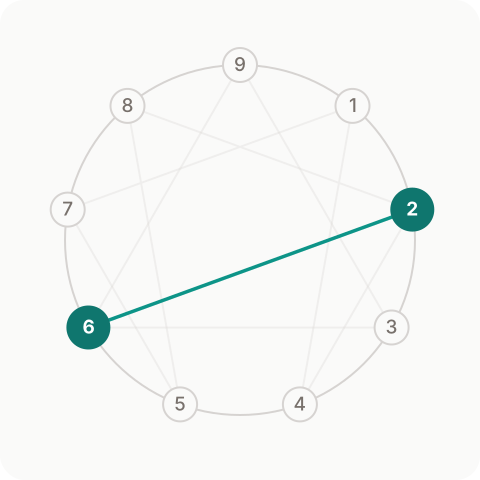
Warmth plus loyalty — a devoted, anxious pair. The Six tests; the Two over-gives. Both settle when reassurance is explicit and regular.
At work
The trust-builders. The Two opens doors, the Six stress-tests what comes through them.
The recurring fight
The signature collision: the Helper argues from the ledger of everything given, while the Loyalist argues from the threat, worst cases deployed as evidence. What de-escalates this specific pairing: the Type-2 partner gets the giving acknowledged before the demand is addressed; the Type-6 partner gets steadiness — the reassurance said before it’s extracted. Order matters less than both arriving in the same conversation.
What each needs from the other
The Helper 2
From a Six, the Two needs its motives taken at face value — generosity tested for hidden agendas eventually stops being offered — and loyalty expressed in words, not only in staying.
The Loyalist 6
From a Two, the Six needs helpfulness that doesn’t blur into management — support offered once, then trusted to be asked for — because unrequested rescue reads as a verdict on its competence.
Daily life together
Their home is a fortress of care: her warmth staffs it, his vigilance walls it. Nobody is better in a family crisis — she carries the people, he carries the logistics and the contingencies. In peacetime the engines idle into each other: she needs to be needed, he needs to be sure, and reassurance becomes the household currency.
When it thrives
Thriving looks like the fortress at peace: her warmth no longer needs to be needed, his vigilance no longer needs to be fed. The healthy version banks trust in both currencies — care given freely, loyalty stated plainly — until the reassurance economy shrinks to a gesture.
How the attraction works
The Two meets the Six’s doubt as a challenge worth winning: Givers like overcoming obstacles to a relationship, and the message becomes ‘believe in me — believe in us.’ The documented early choreography: the Two moves in to help the doubtful partner, and the Six gradually learns to feel safe with that degree of regard. The tradition adds a precise tip: the bond sets fastest when the Two supports the underdog causes that matter to the Six — care aimed at a worthwhile cause reads as trustworthy where flattery aimed at the Six directly triggers the scanner.
The genuineness problem
The pairing’s specific tangle, documented step by step: the Six — afraid of exposure and success — may read the Two’s help as self-serving, wondering what the Two stands to gain and feeling set up as the vehicle for the Two’s ambition. The bind is real: soothed by the care, doubting the flattery, feeling expected to perform — and rebelling instead. When the Six’s stop-start progress then fails the Two’s expected returns, the Two turns actively critical, confirming the Six’s original suspicion. The tradition’s exit is unusually concrete: the Six separates its personal goals from the ones the Two favors and sets its own as the priority — because help aimed at the Six’s chosen goals can be received without the genuineness audit, while help aimed at the Two’s vision of the Six cannot.
At work: trust built in both currencies
This is the trust-building pair — the Two opens doors, the Six stress-tests what comes through them — and at work the combination covers both flanks: relational capital and risk management. The frictions mirror the couple dynamic: a Two manager’s warmth gets audited for agenda by Six employees, and a Six manager’s testing reads as personal distrust to Two employees who run on being valued. What the casework logic prescribes: the Two delivers care in verifiable forms (kept commitments over compliments — a Six banks behavior, not words), and the Six voices its loyalty explicitly rather than assuming its staying is legible. Between these two types, consistency is the love language and the management style at once.
Go deeper
Wings, instincts and health levels all modulate the 2-6 dynamic — health trumps type-matching everywhere. For this pairing specifically, Type 2 vs Type 6 sharpens the individual contrast. The Pro report assembles the full picture for your specific pairing.
Frequently asked questions
Are Type 2 and Type 6 a good match?
Their home is a fortress of care: her warmth staffs it, his vigilance walls it. Whether it thrives depends more on both partners' health levels than on the combination — this page maps where this specific pairing's friction and strength live.
What is the recurring conflict in a 2-6 pair?
What de-escalates this specific pairing: the Type-2 partner gets the giving acknowledged before the demand is addressed; the Type-6 partner gets steadiness — the reassurance said before it's extracted. Order matters less than both arriving in the same conversation.
How do Type 2 and Type 6 handle stress differently?
Their stress signatures differ, and knowing both helps: under stress, Twos erupt into Eight's bluntness: the tally of unthanked favors becomes demands and accusations. Meanwhile, under stress, Sixes perform like an unhealthy Three: workaholic proving, image management, competing for security. Reading a partner's bad season through their stress arrow — instead of taking it personally — is this pairing's cheapest repair.
What growth directions help a 2-6 couple?
Each partner's growth line points the way: moving toward health, Twos gain Four's self-awareness: their own feelings and needs become visible and speakable. And for the other: moving toward health, Sixes gain Nine's calm: trusting themselves and life enough to rest inside it. A couple that names these two directions out loud can back each other's practice instead of accidentally blocking it.
What does the Type 6 partner need in this relationship?
In love, Sixes offer loyalty that outlasts moods. They need consistency — surprises and mixed signals wake the inner alarm. Beside a The Helper, that need is the one most worth saying out loud rather than hoping into existence.
Know your enneagram type. Understand yourself.
Start 7-day free trial