Enneagram 2 and 5 Compatibility: Love & Work
In love
The approacher and the withdrawer. The Two reads the Five’s retreat as rejection; it’s refueling. Distance, honored, becomes the bridge.
At work
Front-of-house and back-of-house. The Two translates the Five to the world; the Five gives the Two’s warmth substance.
The recurring fight
The signature collision: the Helper argues from the ledger of everything given, while the Investigator withdraws and sends the memo. What de-escalates this specific pairing: the Type-2 partner gets the giving acknowledged before the demand is addressed; the Type-5 partner gets time to process before the resolution round. Order matters less than both arriving in the same conversation.
What each needs from the other
The Helper 2
From a Five, the Two needs contact on a schedule it can trust — the Tuesday call that always happens — because predictable small warmth beats unpredictable depth for a heart that counts.
The Investigator 5
From a Two, the Five needs its privacy treated as architecture, not rejection — questions rationed, gifts that don’t obligate — and appreciation for what it says by doing rather than saying.
Daily life together
She warms the house; he steadies it. Her people flow through the kitchen, his books line the study, and the marriage lives in the doorway between — her learning that his closed door isn’t rejection, him learning that her questions aren’t invoices. When it works, each guards what the other lacks: she his heart’s errands, he her right to rest.
When it thrives
Thriving looks like the doorway becoming a room: her warmth granted entry on schedule, his solitude granted legitimacy without suspicion. In the healthy version she reads his three words as the paragraph they are, and he learns to say four.
How the attraction works
The tradition frames this as the meeting of the enneagram’s most contracted type with its most extended: the Two reaches toward others as a way of life, the Five pulls inward as one. Each is drawn to what the other’s structure produces. The Two is fascinated by the Five’s self-possession — someone genuinely at home in themselves, deciding from inside rather than adjusting to placate, and (most precious of all to a relationship-bound Two) largely immune to what other people think. The Five, in turn, is drawn to the open-hearted generosity and appetite for life that Twos display — compelling qualities to someone whose default is aversion. The documented configuration: the Two as the couple’s socialite, speaking for the pair at gatherings, while the contained Five waits for the conversation to reach a topic worth entering.
Distance as architecture, not verdict
The pair’s central translation problem is what withdrawal means. To the Two, distance is data about the relationship — pulling back means something’s wrong, so the Two moves in with attention, questions, care. To the Five, distance is infrastructure — refueling, not rejection — and the Two’s response reads as invasion, triggering deeper retreat. The couple’s documented equilibrium: contact on a rhythm the Five can trust (the standing call, the fixed evening), because predictable small warmth beats unpredictable intensity for a heart that counts, and scheduled contact bypasses the Five’s siege alarm entirely. The Two’s discipline is rationing the questions; the Five’s is voicing the affection it genuinely feels — because a Two starves on inference alone.
At work: front-of-house, back-of-house
The casework describes an unusually natural division of labor: the Two’s orientation to people and needs combined with the Five’s capacity for abstract, isolated work — each finds an appropriate place without needing to negotiate it, and the setup works with either type as boss when the focus stays on task. The documented friction is managerial style: Two managers want to know how employees feel about them personally, which reads as intrusion to Fives — especially attempts to pull the Five into the social scene, or the concern that a Five alone must be unhappy. In its need to be helpful, a Two manager can violate the exact privacy that keeps a Five productive. The rule from the casework: judge the Five by output and initiative, not by visible sociability — and let the Five’s closed door mean what the Five says it means.
Go deeper
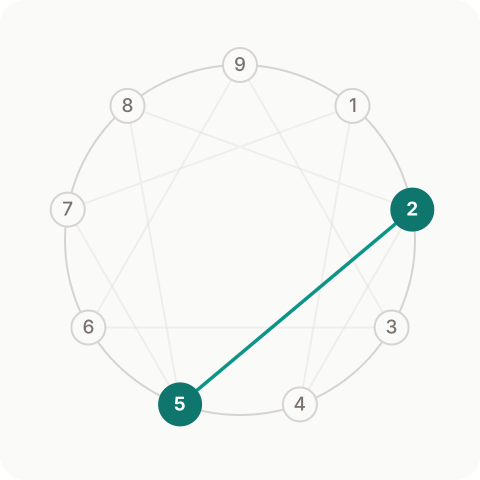
Treat the map above as the default physics, not the forecast — self-knowledge rewrites most of it, and levels outweigh combinations. For this pairing specifically, Type 2 vs Type 5 sharpens the individual contrast. The Pro compatibility tool goes further, including observer-mode typing for a partner who won’t take the test.
Frequently asked questions
Is a 2-5 relationship compatible?
She warms the house; he steadies it. Whether it thrives depends more on both partners' health levels than on the combination — this page maps where this specific pairing's friction and strength live.
What do Type 2 and Type 5 fight about?
What de-escalates this specific pairing: the Type-2 partner gets the giving acknowledged before the demand is addressed; the Type-5 partner gets time to process before the resolution round. Order matters less than both arriving in the same conversation.
How do Type 2 and Type 5 handle stress differently?
Their stress signatures differ, and knowing both helps: under stress, Twos erupt into Eight's bluntness: the tally of unthanked favors becomes demands and accusations. Meanwhile, under stress, Fives scatter into Seven's restlessness: jumpy, distracted, escaping into projects and stimulation. Reading a partner's bad season through their stress arrow — instead of taking it personally — is this pairing's cheapest repair.
What growth directions help a 2-5 couple?
Each partner's growth line points the way: moving toward health, Twos gain Four's self-awareness: their own feelings and needs become visible and speakable. And for the other: moving toward health, Fives gain Eight's embodied confidence: acting on knowledge instead of collecting more. A couple that names these two directions out loud can back each other's practice instead of accidentally blocking it.
What does the Type 2 partner need in this relationship?
In love, Twos lead with attentiveness — they sense needs early and meet them. They need their own needs asked about, not assumed away. In this pairing specifically, that need meets the The Investigator's pattern — naming it early keeps it a request instead of a resentment.
Know your enneagram type. Understand yourself.
Start 7-day free trial