Enneagram 2 and 4 Compatibility: Love & Work
In love
Two feeling-first hearts. The Two moves toward, the Four moves inward — closeness alternates with pursuit. The Two must let the Four come back on its own once.
At work
Emotional intelligence doubled. Great with clients and morale; assign the spreadsheet to someone else.
The recurring fight
The signature collision: the Helper argues from the ledger of everything given, while the Individualist argues from the wound, where this fight is also every previous one. What de-escalates this specific pairing: the Type-2 partner gets the giving acknowledged before the demand is addressed; the Type-4 partner gets the feeling validated before any interpretation is contested. Order matters less than both arriving in the same conversation.
What each needs from the other
The Helper 2
From a Four, the Two needs its giving received without suspicion of shallowness — and one steady signal during the Four’s retreats that the distance isn’t about the Two.
The Individualist 4
From a Two, the Four needs room to return on its own — pursuit reads as engulfment mid-retreat — and its darkness witnessed without a casserole arriving to fix it.
Daily life together
She reads his moods like tide tables and adjusts the house accordingly; he gives her feelings a depth of attention no one else ever has. It’s the pairing where both finally feel emotionally met. The spiral to watch: his withdrawal triggers her pursuit, which deepens his withdrawal — love read by each as its opposite.
When it thrives
Thriving looks like the pursuit retired: she learns his door reopens on its own schedule and stops knocking; he learns her care isn’t shallow and stops testing it. The healthy version is the pairing both dreamed of — depth fully attended, attention fully deep.
How the attraction works
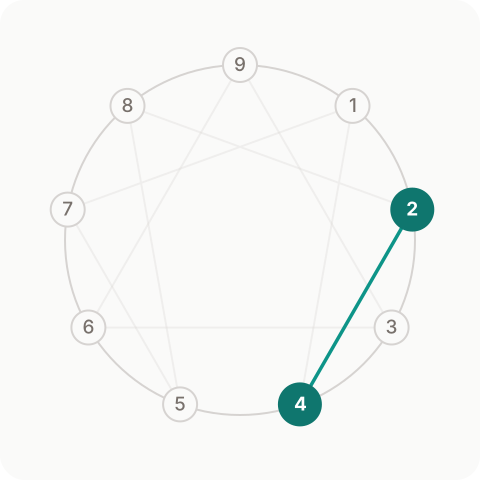
The tradition maps this couple onto a push-pull pattern both types already carry: each pulls back when a partner is available and pursues when the partner disappears — which between a Two and a Four becomes a genuine romantic tango. You come forward, I go backward; you go backward, I want you again. Underneath the choreography is the real draw: each appreciates the other’s capacity for feeling, and at last there’s the possibility of being met emotionally. The pair shares the Two-Four line of the diagram, meaning each knows the other’s territory from inside — the Two knows what longing feels like; the Four knows what it is to earn closeness by attunement.
The dance of distance
The choreography has a documented engine: both partners are afraid to commit, and the alternating pursuit disguises that fear as passion. The Two’s version: love as helping, with retreat when the helping is no longer needed. The Four’s version: longing for what’s distant, with deflation when it arrives. Together they can sustain remarkable romantic intensity — and mistake the intensity for depth while the actual commitment question goes unasked for years. The intervention the pattern responds to: synchronized stillness — deliberately staying present at the same time, at low drama, long enough for both to notice that met closeness, while less electric than pursued closeness, is the thing both fears were guarding against and both hearts wanted.
At work: the belonging workshop
Professionally this pair builds workplaces with unusual ambience: Fours need to feel special and Twos cultivate relationships of all kinds, so even in anonymous settings, personal life gets attention — you know each other’s stories here; the workplace becomes a place of belonging, and the casework stresses this is motivation, not time-wasting. The friction is aesthetic and specific: Two managers use their persona to conduct business, and Fours — watching the visible effort to draw attention — find it tasteless, almost an exposure of the Two’s stress point (‘how can she be so obvious?’). The Four withholds; the Two reads withholding as ingratitude. What works: the Two dialing the persona down around the Four and delivering attention privately; the Four saying the appreciation the Two’s effort actually earns.
Go deeper
This page sketches the average band; your actual pairing shifts with each partner’s wing, instinct stack and current level. For this pairing specifically, Type 2 vs Type 4 sharpens the individual contrast. For the complete interactive analysis, see the Pro report.
Frequently asked questions
Do Type 2 and Type 4 work as a couple?
She reads his moods like tide tables and adjusts the house accordingly; he gives her feelings a depth of attention no one else ever has. Whether it thrives depends more on both partners' health levels than on the combination — this page maps where this specific pairing's friction and strength live.
Where does a 2-4 couple clash most?
What de-escalates this specific pairing: the Type-2 partner gets the giving acknowledged before the demand is addressed; the Type-4 partner gets the feeling validated before any interpretation is contested. Order matters less than both arriving in the same conversation.
How do Type 2 and Type 4 handle stress differently?
Their stress signatures differ, and knowing both helps: under stress, Twos erupt into Eight's bluntness: the tally of unthanked favors becomes demands and accusations. Meanwhile, under stress, Fours grasp like an unhealthy Two: clinging, needing to be needed, testing people's love. Reading a partner's bad season through their stress arrow — instead of taking it personally — is this pairing's cheapest repair.
What growth directions help a 2-4 couple?
Each partner's growth line points the way: moving toward health, Twos gain Four's self-awareness: their own feelings and needs become visible and speakable. And for the other: moving toward health, Fours gain One's discipline: feelings become material for work instead of weather that cancels it. A couple that names these two directions out loud can back each other's practice instead of accidentally blocking it.
How do Type 2 and Type 4 collaborate at work?
At work, Twos are the relational glue: mentoring, smoothing, connecting. Friction: unacknowledged effort curdles into resentment. And the other side: at work, Fours bring taste, meaning and originality. Friction: routine drains them, and comparison stings. The collaboration works when each covers the other's friction point on purpose.
Know your enneagram type. Understand yourself.
Start 7-day free trial