Two Type 2s Together: Enneagram 2-2 Compatibility
In love
Endless mutual attentiveness — and a standoff of unstated needs. Whoever asks for something first, wins for both.
At work
A warm, generous team that quietly competes for being the most needed. Rotate the visible helper role.
The recurring fight
When two Type 2s clash, both run the same play: each argues from the ledger of everything given. The collision is symmetric — both run the same play, so neither supplies the counterweight. What breaks the symmetry: one partner deliberately supplies what both are waiting for — for two Type 2s, that means the giving acknowledged before the demand is addressed, offered first, without scoreboard.
What each needs from the other
The Helper 2 + 2
Two Twos need turns — a literal rotation of who receives this week — because two skilled givers can starve politely forever, each waiting to be read the way they read.
Daily life together
Their kitchen produces more food than the household consumes — the surplus flows outward to neighbors, church, anyone flagged as struggling. Both partners track everyone’s needs except each other’s, each assuming the other will read theirs unprompted, each too practiced at seeming fine. The house is warm; its center is quietly hungry.
When it thrives
Thriving looks like the rotation honored: this week she receives, next week he does, and the surplus care flows outward instead of colliding in the kitchen. The healthy version discovers the astonishing thing both were starving for — that being read by someone who reads is the rest neither ever had.
How the attraction works
The tradition observes that double-Two couples are a rare sighting, and explains why with unusual candor: if you’re in the giving business, you look for someone to help — and with two Givers there’s no one to receive. Each partner is embarrassed at the center of attention; each prefers to share glory from behind the scenes, pulling strings so someone else can shine and being spared the risk of public failure. Where the pairing does form, it’s frequently as deep friendship first: two people who recognize each other’s radar and can — with practice — do for each other what neither allows anyone else to do: make them receive.
The setup: ‘I’m being forced to go first’
The documented double-Two trap is a standoff of receiving: each thinks ‘I’m being forced to go first’ — forced to have needs, to be the one helped, to occupy the center. The tradition’s corrective is a redefinition of relating itself: relating doesn’t mean denying your needs, refusing to be separate, or living entirely outside yourself. Only half a relationship can be built on serving a partner’s potential; the other half is developing your own. In practice this means the literal rotation this site keeps prescribing for the pair — a schedule of receiving, because scheduled receiving bypasses the embarrassment that spontaneous receiving triggers — plus separate projects each partner owns for its own sake, not as service.
At work: two promoters, one task
Professionally the double Two does well through an elegant mechanism the casework names: both can serve the task as if it were a third party — a task has needs, a task provides identity, a task has emotional juice. Two skilled promoters focused on a common effort make a graceful, productive team, provided each holds an equally important role; otherwise they compete to be indispensable. The shadow is documented specifically: Two managers lead aggressively for popular decisions but turn manipulative when they become hostility’s focal point — working the power structure, going over heads, seducing the elite — and Two employees can put down peers to impress management. The prevention, verbatim from the casework’s logic: clear boundaries and clear structure make manipulation unnecessary — the relational energy stays on the task when the roles can’t be gamed.
Go deeper
Treat the map above as the default physics, not the forecast — self-knowledge rewrites most of it, and levels outweigh combinations. For a household of two Type 2s, each partner’s wing page is where the differences hide. The Pro compatibility tool goes further, including observer-mode typing for a partner who won’t take the test.
Frequently asked questions
Is a 2-2 relationship compatible?
Their kitchen produces more food than the household consumes — the surplus flows outward to neighbors, church, anyone flagged as struggling. Whether it thrives depends more on both partners' health levels than on the combination — this page maps where this specific pairing's friction and strength live.
What do Type 2 and Type 2 fight about?
What breaks the symmetry: one partner deliberately supplies what both are waiting for — for two Type 2s, that means the giving acknowledged before the demand is addressed, offered first, without scoreboard.
How does a double Type 2 couple handle stress?
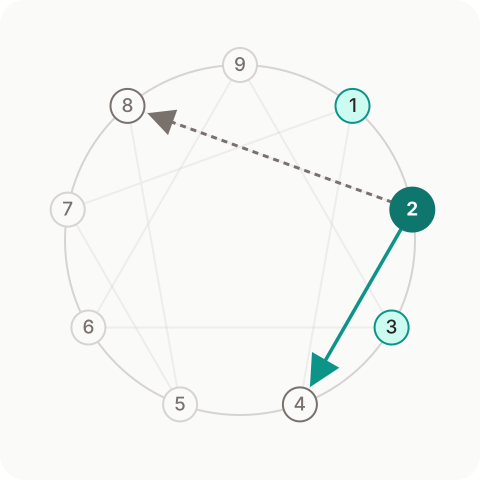
Doubly, in the same direction: under stress, Twos erupt into Eight's bluntness: the tally of unthanked favors becomes demands and accusations. When both partners travel that arrow at once, nobody holds the baseline — which is why same-type couples benefit from an outside stabilizer and an agreed signal for hard weeks.
What growth work helps two Type 2s most?
The shared growth line is an advantage: moving toward health, Twos gain Four's self-awareness: their own feelings and needs become visible and speakable. Two people working the same direction can genuinely accelerate each other — provided they don't also share the same excuse on the same day.
What does each partner in a 2-2 couple need to hear?
In love, Twos lead with attentiveness — they sense needs early and meet them. They need their own needs asked about, not assumed away. In this pairing specifically, that need meets the The Helper's pattern — naming it early keeps it a request instead of a resentment.
Know your enneagram type. Understand yourself.
Start 7-day free trial