Enneagram 1 and 7 Compatibility: Love & Work
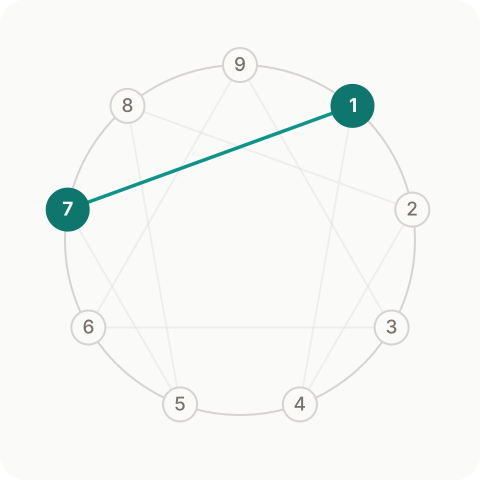
In love
Discipline marries delight. The Seven frees the One’s suppressed play; the One gives the Seven’s plans a spine. The fight: spontaneity vs the standing plan.
At work
Vision and vetting. The Seven opens doors, the One checks the floor. Agree on when brainstorm ends and commitment starts.
The recurring fight
The signature collision: the Reformer argues from the rulebook — calm, precise, quietly furious, while the Enthusiast reframes mid-fight — it’s not that bad, look at it this way. What de-escalates this specific pairing: the Type-1 partner gets the valid point conceded before the rest is disputed; the Type-7 partner gets one full acknowledgment of the problem before any silver lining. Order matters less than both arriving in the same conversation.
What each needs from the other
The Reformer 1
From a Seven, the One needs the fun to include the plan — spontaneity announced an hour ahead is still spontaneity to a One — and its discipline teased gently, never mocked.
The Enthusiast 7
From a One, the Seven needs play taken seriously — joy treated as legitimate, not as the reward after an audit — and its escapes asked about with curiosity instead of graded.
Daily life together
Their fridge tells the story: his meal plan on the door, her festival tickets under the magnet. The marriage works as an exchange program — he lends structure, she lends permission. Their best days are planned adventures; their worst are audits of each other’s operating system.
When it thrives
Thriving looks like the exchange program completing: his days gain her color, her plans gain his follow-through, and each stops grading the other’s operating system. The healthy version alternates sovereignty — her Saturday, his Sunday — until the styles interleave on their own.
How the attraction works
One and Seven sit on a shared line of the diagram, and the tradition notes each sees a major missing aspect of itself in the other. From the Seven side, the One’s clarity is the draw: discipline, principle, follow-through — a focused concentration that can ground the Seven’s planning monkey-mind. From the One side, Epicurean spontaneity is nearly irresistible: the Seven enlivens a household until an evening by the fire takes on theatrical proportions and holidays expand into heroic events. The Seven is, in the geometry, the One’s security point — which is why the partnership can feel to the One like permission it could never write for itself.
The discipline-of-joy exchange
The couple’s economy is an exchange of licenses: the Seven licenses the One’s suppressed play, the One licenses the Seven’s postponed follow-through. The strain arrives when either partner suspends the exchange — the One auditing the fun (‘was that worth the money? was the itinerary honest?’) or the Seven treating the One’s structure as a cage to escape rather than a base to launch from. The pattern to watch is asymmetric contempt: the One privately grading the Seven as unserious, the Seven privately diagnosing the One as repressed. Both verdicts are the pattern talking. The couple thrives on planned spontaneity — adventures with a frame — which sounds like an oxymoron and is actually the precise overlap of both types’ needs.
At work: linear meets multioptional
The documented friction is cognitive style: the Seven thinks in interlocking concepts and needs flexible structure that absorbs new ideas; the One can’t easily follow multioptional thought, and the Seven feels boxed by linear procedure. The killer interaction, from the casework: the One manager points out small mistakes, and the Seven — caught off guard — retreats behind excuses: ‘I meant it that way,’ ’the timing wasn’t right.’ To the One these evasions read as lies, when for the Seven they’re ‘process thought’ — narrating an unfinished trajectory as if it were the plan. The prescriptions: a light supervisory touch, evaluation by results rather than method, and — for the Seven managing a One — precise briefs and honored commitments, because every cheerful revision teaches the One that nothing here can be trusted.
Go deeper
This page sketches the average band; your actual pairing shifts with each partner’s wing, instinct stack and current level. For this pairing specifically, Type 1 vs Type 7 sharpens the individual contrast. For the complete interactive analysis, see the Pro report.
Frequently asked questions
Do Type 1 and Type 7 work as a couple?
Their fridge tells the story: his meal plan on the door, her festival tickets under the magnet. Whether it thrives depends more on both partners' health levels than on the combination — this page maps where this specific pairing's friction and strength live.
Where does a 1-7 couple clash most?
What de-escalates this specific pairing: the Type-1 partner gets the valid point conceded before the rest is disputed; the Type-7 partner gets one full acknowledgment of the problem before any silver lining. Order matters less than both arriving in the same conversation.
How do Type 1 and Type 7 handle stress differently?
Their stress signatures differ, and knowing both helps: under sustained stress, Ones slide toward the moody side of Four: alienated, misunderstood, quietly despairing of ever being good enough. Meanwhile, under stress, Sevens turn harsh like an unhealthy One: critical, impatient, perfectionistic about their escapes. Reading a partner's bad season through their stress arrow — instead of taking it personally — is this pairing's cheapest repair.
What growth directions help a 1-7 couple?
Each partner's growth line points the way: moving toward health, Ones relax into Seven's spontaneity: more play, more possibility, less tribunal. And for the other: moving toward health, Sevens gain Five's depth: fewer things, fully tasted; satisfaction replaces anticipation. A couple that names these two directions out loud can back each other's practice instead of accidentally blocking it.
What does the Type 1 partner need in this relationship?
In love, Ones show care through reliability and improvement — remembering, fixing, keeping promises. They need appreciation for their effort and room to relax their inner critic. In this pairing specifically, that need meets the The Enthusiast's pattern — naming it early keeps it a request instead of a resentment.
Know your enneagram type. Understand yourself.
Start 7-day free trial