Enneagram 1 and 6 Compatibility: Love & Work
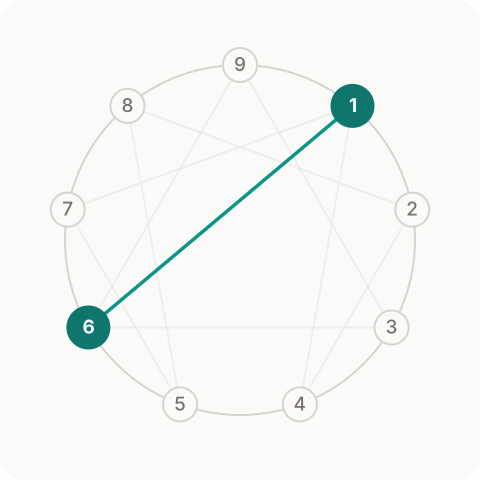
In love
Loyal, responsible, promise-keeping. The Six’s doubts meet the One’s certainties — steadying when kind, corrosive when judging.
At work
The compliance dream team. Both catastrophize differently: the One about errors, the Six about threats — name which is speaking.
The recurring fight
The signature collision: the Reformer argues from the rulebook — calm, precise, quietly furious, while the Loyalist argues from the threat, worst cases deployed as evidence. What de-escalates this specific pairing: the Type-1 partner gets the valid point conceded before the rest is disputed; the Type-6 partner gets steadiness — the reassurance said before it’s extracted. Order matters less than both arriving in the same conversation.
What each needs from the other
The Reformer 1
From a Six, the One needs its decisions trusted after the first vetting — re-opened verdicts feel like accusations of carelessness to someone who checked everything twice already.
The Loyalist 6
From a One, the Six needs consistency more than correctness — the promise kept exactly as spoken — because every silent revision of the plan, however principled, feeds the scanner.
Daily life together
Theirs is the house with the fire extinguisher AND the inspection certificate. Responsibility squared: bills early, warranties filed, wills updated. They trust each other more than either trusts the world. The loop to watch: her what-ifs feed his shoulds, and an ordinary Tuesday ends with both improving contingencies nobody needed.
When it thrives
Thriving looks like trust with receipts that stop being needed: his consistency retires her testing, her loyalty retires his self-audit. The healthy version keeps one shared discipline — worry gets an hour, not the evening — and spends the freed time on the life all that responsibility was supposedly for.
How the attraction works
The One-Six couple is often dedicated to a dream that requires hard work — the tradition’s phrase — bonding through effort and a kinship of ideals. The Six’s identification with underdog causes meets the One’s dedication to getting things right, and the two build a shared worldview that’s prepared for adversity and dignified by it. Both are ’negative thinkers’ in the technical sense — the One preoccupied with error, the Six with doubt — and precisely because they anticipate difficulty together, they also share the darker gifts: hard questions asked seriously, the courage of daring to try, the creativity that springs from pain taken honestly rather than denied.
Error meets doubt
The couple’s engine room holds two different alarm systems that can either calibrate or amplify each other. The One’s alarm points at wrongness (something must be corrected), the Six’s at threat (something must be secured) — and each partner can mistake the other’s alarm for their own category: the Six hears the One’s criticism as danger, the One hears the Six’s worry as sloppiness about facts. Amplification looks like a household perpetually braced. Calibration — the healthy version — looks like division of vigilance: the One audits what’s controllable, the Six scans what isn’t, and each explicitly retires the other’s off-duty hours. The practice that carries it: naming which alarm is speaking (’this is my error-bell, not a real threat’) before the partner’s system picks up the ring.
At work: the benevolent-authority requirement
This pairing works best, per the casework, when the One is a benevolent authority and the Six can meet standards under it — mutual support inside clear structure. The specific managerial lesson: Ones are sparing with praise because their attention lives on flaws, and Six employees interpret the absence of praise in the worst available light — feeling targeted, building a case, spreading the alarm to colleagues (‘can this manager be trusted? how do we know?’). Even the manager’s unrelated irritation — morning traffic — gets registered and referred to the Six’s worst-case file. The fix is cheap and specific: reassurance delivered even when it seems unnecessary, praise stated at regular intervals as infrastructure rather than reward, and bad news given early with its actual scope attached.
Go deeper
Wings, instincts and health levels all modulate the 1-6 dynamic — health trumps type-matching everywhere. For this pairing specifically, Type 1 vs Type 6 sharpens the individual contrast. The Pro report assembles the full picture for your specific pairing.
Frequently asked questions
Are Type 1 and Type 6 a good match?
Theirs is the house with the fire extinguisher AND the inspection certificate. Whether it thrives depends more on both partners' health levels than on the combination — this page maps where this specific pairing's friction and strength live.
What is the recurring conflict in a 1-6 pair?
What de-escalates this specific pairing: the Type-1 partner gets the valid point conceded before the rest is disputed; the Type-6 partner gets steadiness — the reassurance said before it's extracted. Order matters less than both arriving in the same conversation.
How do Type 1 and Type 6 handle stress differently?
Their stress signatures differ, and knowing both helps: under sustained stress, Ones slide toward the moody side of Four: alienated, misunderstood, quietly despairing of ever being good enough. Meanwhile, under stress, Sixes perform like an unhealthy Three: workaholic proving, image management, competing for security. Reading a partner's bad season through their stress arrow — instead of taking it personally — is this pairing's cheapest repair.
What growth directions help a 1-6 couple?
Each partner's growth line points the way: moving toward health, Ones relax into Seven's spontaneity: more play, more possibility, less tribunal. And for the other: moving toward health, Sixes gain Nine's calm: trusting themselves and life enough to rest inside it. A couple that names these two directions out loud can back each other's practice instead of accidentally blocking it.
How do Type 1 and Type 6 collaborate at work?
At work, Ones bring standards, structure and follow-through. Friction: criticism lands hard, and 'good enough' feels like a betrayal. And the other side: at work, Sixes are the early-warning system and the faithful executor. Friction: ambiguity from leadership reads as danger. The collaboration works when each covers the other's friction point on purpose.
Know your enneagram type. Understand yourself.
Start 7-day free trial