Enneagram 1 and 5 Compatibility: Love & Work
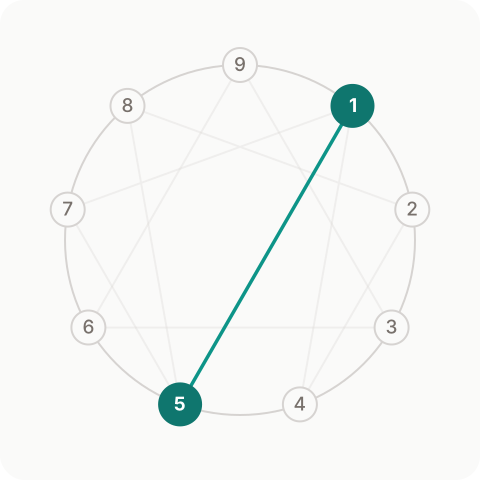
In love
Two reserved interiors that respect each other’s autonomy. Warmth must be scheduled or it won’t happen — neither initiates closeness under stress.
At work
Rigor squared: standards plus analysis. Decisions are sound and slow; appoint a deadline-keeper.
The recurring fight
The signature collision: the Reformer argues from the rulebook — calm, precise, quietly furious, while the Investigator withdraws and sends the memo. What de-escalates this specific pairing: the Type-1 partner gets the valid point conceded before the rest is disputed; the Type-5 partner gets time to process before the resolution round. Order matters less than both arriving in the same conversation.
What each needs from the other
The Reformer 1
From a Five, the One needs engagement on the shared duties without being made to ask twice — the trash taken out unprompted reads as moral partnership, not chores.
The Investigator 5
From a One, the Five needs its withdrawal read as refueling, not dereliction — and standards negotiated once, calmly, rather than enforced in daily inspections.
Daily life together
Two quiet perfectionisms share the space: his procedural, hers epistemic. Dinner conversation is genuinely interesting and nobody interrupts. The house is clean and the library organized — by different logics, each privately convinced theirs is correct. What’s missing goes unnoticed for years: nobody’s job is warmth.
When it thrives
Thriving looks like quiet mutual reliability with scheduled warmth: the standing walk, the shared project, the conversation that goes deep because nobody’s performing. The healthy version assigns the missing function deliberately — affection gets a calendar slot, and both discover they wanted it there all along.
How the attraction works
This is the tradition’s pragmatic marriage: both partners like to work alone, both value emotional control, and the shared life often organizes around livelihood, practical projects and a well-ordered household rather than romance performed. The mutual respect is real and quiet — two people who don’t invade each other. The specific tension the casework documents: the Five’s blank affect feeds the One’s worry machinery. An Observer can be emotionally flat for days while the One clenches, waiting for the critical shoe to drop — when in truth the Five may simply not care about the matter at all. The One reads silence as judgment because that’s what its own silence would be.
Getting anger into the room
Neither partner wants anger, so important topics go unaddressed — and the tradition’s finding for this pair is specific: the tension eases when the Five speaks, and dissolves when the Five will actually fight. To a One, anger from a Five is evidence of investment — proof there’s someone home who cares about the outcome. The couple’s practice is therefore scheduled directness: standing time where held topics get said plainly, at low stakes, before they compost. The One contributes by receiving the Five’s first drafts without audit (a Five whose early attempts get corrected files everything thereafter), and the Five contributes by voicing preferences while they’re small — the three-word version beats the unsent memo.
At work: the efficiency alliance
Joined in their powers of criticism and practical to the point of thriftiness, this pair excels at clearing systems of inefficiency and waste — the documented specialty. Work styles align remarkably: the Five manager sets clear objectives and proceeds methodically, which pleases the One; both are independent workers who want assignments they can shape alone; the emphasis stays on formal contact rather than social performance, which suits them both. The tug-of-war is informational: when the One wants more reporting, the Five gives less. What helps, from the casework: fixed, explicit requirements — the Five delivers precisely when it knows exactly how much is required, and the One manager must resist calling for further improvement once stated standards have been met. Moving the bar after the fact reads to a Five as siege, and the drawbridge goes up.
Go deeper
Treat the map above as the default physics, not the forecast — self-knowledge rewrites most of it, and levels outweigh combinations. For this pairing specifically, Type 1 vs Type 5 sharpens the individual contrast. The Pro compatibility tool goes further, including observer-mode typing for a partner who won’t take the test.
Frequently asked questions
Is a 1-5 relationship compatible?
Two quiet perfectionisms share the space: his procedural, hers epistemic. Whether it thrives depends more on both partners' health levels than on the combination — this page maps where this specific pairing's friction and strength live.
What do Type 1 and Type 5 fight about?
What de-escalates this specific pairing: the Type-1 partner gets the valid point conceded before the rest is disputed; the Type-5 partner gets time to process before the resolution round. Order matters less than both arriving in the same conversation.
How do Type 1 and Type 5 handle stress differently?
Their stress signatures differ, and knowing both helps: under sustained stress, Ones slide toward the moody side of Four: alienated, misunderstood, quietly despairing of ever being good enough. Meanwhile, under stress, Fives scatter into Seven's restlessness: jumpy, distracted, escaping into projects and stimulation. Reading a partner's bad season through their stress arrow — instead of taking it personally — is this pairing's cheapest repair.
What growth directions help a 1-5 couple?
Each partner's growth line points the way: moving toward health, Ones relax into Seven's spontaneity: more play, more possibility, less tribunal. And for the other: moving toward health, Fives gain Eight's embodied confidence: acting on knowledge instead of collecting more. A couple that names these two directions out loud can back each other's practice instead of accidentally blocking it.
What does the Type 5 partner need in this relationship?
In love, Fives give presence in small, real doses and deep loyalty. They need unhurried space — intimacy grows when it doesn't demand. Beside a The Reformer, that need is the one most worth saying out loud rather than hoping into existence.
Know your enneagram type. Understand yourself.
Start 7-day free trial