Enneagram 1 and 4 Compatibility: Love & Work
In love
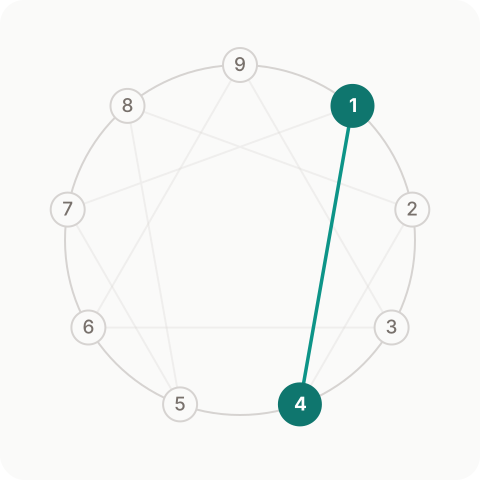
Order meets depth. The Four brings color the One won’t allow itself; the One brings ground the Four can’t find alone. Criticism is the third rail.
At work
Craft plus taste. The One edits, the Four creates — brilliant while feedback stays about the work, not the person.
The recurring fight
The signature collision: the Reformer argues from the rulebook — calm, precise, quietly furious, while the Individualist argues from the wound, where this fight is also every previous one. What de-escalates this specific pairing: the Type-1 partner gets the valid point conceded before the rest is disputed; the Type-4 partner gets the feeling validated before any interpretation is contested. Order matters less than both arriving in the same conversation.
What each needs from the other
The Reformer 1
From a Four, the One needs feelings delivered with a handle — ‘I’m sad, it’s not about you, I need an hour’ — instead of weather the One feels responsible for fixing.
The Individualist 4
From a One, the Four needs its intensity treated as real rather than excessive — the mood met with curiosity before correction — and reassurance that the relationship’s rules survive its storms.
Daily life together
Their home holds a negotiated aesthetic: his order underneath, her beauty on top — the labeled pantry behind the hand-thrown ceramics. At best it’s a gallery that functions. The recurring scene: she reads his tidying as erasure of her texture; he reads her creative chaos as a moral hazard spreading from the studio.
When it thrives
Thriving looks like the gallery that functions: her beauty given structure that protects it, his order given meaning that softens it. In the healthy version he learns her chaos is a kiln, not a hazard — and she learns his tidying is tenderness with gloves on.
How the attraction works
The tradition calls this pairing volatile and unusually rich in self-understanding, because the two types share a line on the diagram: each sees a version of themselves in the other. The Four acts out the ‘improper’ emotions the One has spent a lifetime suppressing — shame, envy, despair on the way to creativity — and the One both recoils from and needs the sight. In the other direction, the One models the discipline and follow-through that the Four’s inner weather keeps cancelling. The couple’s documented gift: the Four can introduce the One to a life of feelings rather than right-or-wrong rulings, and the One can give the Four’s depth a container that holds.
The criticism-shame spiral
The pairing’s signature failure cycle is documented step by step: the One reads the Four’s dramatic moods as self-indulgence (‘pull yourself together, there’s work to be done’), the criticism confirms the Four’s core sense of deficiency, and the Four retaliates with the accusation that hurts a One most — ‘you’re unfeeling, you can’t be touched’ — with the implication that the Four is the better person for feeling deeply. Each round tightens the next. The interruption points, per the casework: the Four seeing why the One controls emotion (fear of its own shadow, not absence of depth), and the One learning to meet a mood with curiosity before correction. In the work version, the tradition notes these fights can actually heal when mediated: the One gets to be angry without guilt, and the Four experiences having its flaws exposed without being abandoned.
At work: perfect standards, unique standards
Professionally the pair bonds in excellence — the One’s perfect standards and the Four’s unique ones meet in mutual respect for special achievement and joint contempt for the substandard. The One manager’s structure genuinely suits the Four: order is a container for feelings, and a well-run setting reads as safety. The friction point is impersonality — a One who manages through rules and convention gets dismissed by the Four as emotionally dishonest, making rules more important than people, and a Four denied special treatment doesn’t argue with the rules; it simply ignores them. Four managers, meanwhile, either run the office with Three-like precision or schedule it around their own emotional weather — and the One employee, wanting the calendar orderly and the supervision predictable, grows quietly frantic in the second case. The treaty: personal contact from the One, professional predictability from the Four.
Go deeper
This page sketches the average band; your actual pairing shifts with each partner’s wing, instinct stack and current level. For this pairing specifically, Type 1 vs Type 4 sharpens the individual contrast. For the complete interactive analysis, see the Pro report.
Frequently asked questions
Do Type 1 and Type 4 work as a couple?
Their home holds a negotiated aesthetic: his order underneath, her beauty on top — the labeled pantry behind the hand-thrown ceramics. Whether it thrives depends more on both partners' health levels than on the combination — this page maps where this specific pairing's friction and strength live.
Where does a 1-4 couple clash most?
What de-escalates this specific pairing: the Type-1 partner gets the valid point conceded before the rest is disputed; the Type-4 partner gets the feeling validated before any interpretation is contested. Order matters less than both arriving in the same conversation.
How do Type 1 and Type 4 handle stress differently?
Their stress signatures differ, and knowing both helps: under sustained stress, Ones slide toward the moody side of Four: alienated, misunderstood, quietly despairing of ever being good enough. Meanwhile, under stress, Fours grasp like an unhealthy Two: clinging, needing to be needed, testing people's love. Reading a partner's bad season through their stress arrow — instead of taking it personally — is this pairing's cheapest repair.
What growth directions help a 1-4 couple?
Each partner's growth line points the way: moving toward health, Ones relax into Seven's spontaneity: more play, more possibility, less tribunal. And for the other: moving toward health, Fours gain One's discipline: feelings become material for work instead of weather that cancels it. A couple that names these two directions out loud can back each other's practice instead of accidentally blocking it.
What does the Type 1 partner need in this relationship?
In love, Ones show care through reliability and improvement — remembering, fixing, keeping promises. They need appreciation for their effort and room to relax their inner critic. In this pairing specifically, that need meets the The Individualist's pattern — naming it early keeps it a request instead of a resentment.
Know your enneagram type. Understand yourself.
Start 7-day free trial