Two Type 1s Together: Enneagram 1-1 Compatibility
In love
Two consciences in one house: deeply principled, mutually respectful — and prone to competing correctness. The growth edge is letting play outrank improvement one evening a week.
At work
Impeccable standards, doubled — with the risk of gridlock over the right way. Agree early on whose call is final per domain.
The recurring fight
When two Type 1s clash, both run the same play: each argues from the rulebook — calm, precise, quietly furious. The collision is symmetric — both run the same play, so neither supplies the counterweight. What breaks the symmetry: one partner deliberately supplies what both are waiting for — for two Type 1s, that means the valid point conceded before the rest is disputed, offered first, without scoreboard.
What each needs from the other
The Reformer 1 + 1
Two Ones need a shared amnesty ritual — a standing agreement about which domains are exempt from improvement — and the discipline to praise each other’s work before editing it.
Daily life together
Visit their home and you’ll feel it before you can name it: everything works, everything’s level, and somewhere a shared spreadsheet governs the maintenance schedule. The affection is real and runs through standards — each trusts the other completely, because each knows the other audited themselves first.
When it thrives
Thriving looks like two crafts sharing a workshop: each partner’s discipline aimed at different domains, mutual review invited rather than imposed, and — the mark of the healthy version — laughter about the pattern itself. When two Ones can joke about their shared tribunal, the tribunal has already lost its quorum.
How the attraction works
Two Ones find each other with relief: at last, someone else who cares about doing it right. The tradition’s couples-panel observation is precise — meeting another One is like one Atlas discovering a second, another shoulder already under the world. The bond forms around earned achievement and shared standards: good food done properly, children raised on principle, projects that hold the household together. Criticism, surprisingly, is part of the intimacy: for Ones, being openly critical with someone is a sign of trust and investment, and its absence — the polite silence — is the real warning sign. A long-standing double-One couple will tell you their closeness deepened the first time they fought openly and discovered that everything they were afraid to say could be said, and nobody died.
The characteristic argument cycle
The double-One fight has a documented shape: slow buildup, short explosive tussle, long silent standoff, gradual re-engagement as forgiveness takes place. The buildup phase is the dangerous one — each partner privately files the other’s imperfections while presenting composure, and the eventual detonation is out of proportion to its trigger because it carries the whole file. Two accelerants are specific to this pairing: the comparison attack (‘who is better?’ — an insecurity signal inherited from the childhood belief that being perfect earns love) and the ‘you go first’ standoff, where each criticizes the other for not improving while privately fearing to fail in the other’s eyes. Safe anger is the pressure valve: heated agreement about outside topics — politics, causes, the neighbor’s fence — opens the conduit for personal matters before the file gets heavy.
At work: the quality alliance and its trap
Professionally, double One is a mutuality of purpose — hard work, earned advancement, devotion to craft — and half the fun is the debrief, picking apart everyone else’s presentations with the one other person who noticed everything. The documented trap is the liaison of superiority: a small exclusive club of correctness that keeps itself up by putting others down. In manager-employee form, control struggles surface as stony correctness on both sides — the standoff where each waits for the other to break by showing anger, each monitoring for the other’s mistake. What helps, per the tradition’s casework: explicit division of labor (Ones respond to a visible job sheet — fairness made legible), outside expert counsel for stuck decisions (Ones trust credible consultants where they distrust improvisation), and systems loosened enough that both sides can save face.
Go deeper
This page sketches the average band; your actual pairing shifts with each partner’s wing, instinct stack and current level. For a household of two Type 1s, each partner’s wing page is where the differences hide. For the complete interactive analysis, see the Pro report.
Frequently asked questions
Do Type 1 and Type 1 work as a couple?
Visit their home and you'll feel it before you can name it: everything works, everything's level, and somewhere a shared spreadsheet governs the maintenance schedule. Whether it thrives depends more on both partners' health levels than on the combination — this page maps where this specific pairing's friction and strength live.
Where does a 1-1 couple clash most?
What breaks the symmetry: one partner deliberately supplies what both are waiting for — for two Type 1s, that means the valid point conceded before the rest is disputed, offered first, without scoreboard.
How does a double Type 1 couple handle stress?
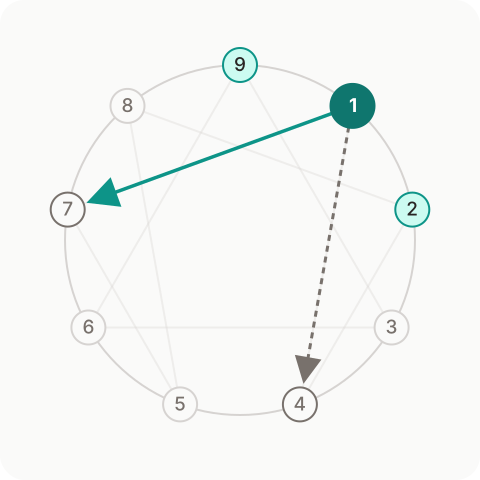
Doubly, in the same direction: under sustained stress, Ones slide toward the moody side of Four: alienated, misunderstood, quietly despairing of ever being good enough. When both partners travel that arrow at once, nobody holds the baseline — which is why same-type couples benefit from an outside stabilizer and an agreed signal for hard weeks.
What growth work helps two Type 1s most?
The shared growth line is an advantage: moving toward health, Ones relax into Seven's spontaneity: more play, more possibility, less tribunal. Two people working the same direction can genuinely accelerate each other — provided they don't also share the same excuse on the same day.
What does each partner in a 1-1 couple need to hear?
In love, Ones show care through reliability and improvement — remembering, fixing, keeping promises. They need appreciation for their effort and room to relax their inner critic. In this pairing specifically, that need meets the The Reformer's pattern — naming it early keeps it a request instead of a resentment.
Know your enneagram type. Understand yourself.
Start 7-day free trial